
Perquimans Projected and Actual Dates
NC DAC Offender Public Information uses the exact label “Projected Release Date” in incarceration or sentence detail. It is a calculation based on the record at that time. A historical block may also show “Actual Release Date,” which records that the prison portion ended for that sentence. Neither label should be read alone. The overall inmate status, service status, current location, supervision status, and every sentence block can change what the date means.
A person released from prison may begin post-release supervision rather than complete the whole sentence. The actual prison release is still real, but “discharged” would be too broad while supervision remains active. A transfer from Albemarle District Jail to NC DAC is also not a release to the community. It starts a different custody record.
Pretrial custody works differently. A person held at Albemarle District Jail before judgment has no sentence-based projected date. Bond action, dismissal, a court order, a detainer, or trial may control the next event. The jail and court case are the correct sources.
A bond amount or hearing date should not be converted into an expected exit date. Staff must receive and process the controlling authority, address holds, and complete the release event. If another agency has a detainer, the person may leave Albemarle while remaining in custody. Ask for the release disposition and destination, not just the date.
Lookup a Perquimans Projected Release
First decide whether the person is in local jail custody or the North Carolina state prison system. OPI covers state prison and community supervision history from 1972 onward. It does not cover a jail-only detention at Albemarle. A person convicted in Perquimans County can serve a state sentence elsewhere, so the physical prison need not be within the county.
- Open the NC DAC OPI search. Use an offender number when known, or search by name with birth and age filters.
- Match the correct person. Read overall “Inmate Status” and “Probation/Parole/Post Release Status” before opening individual sentences.
- Review current location, incarceration status, admission data, county of conviction, docket, offense, sentence begin date, minimum and maximum term, and service status.
- Find the controlling active block and read “Projected Release Date.” Check other blocks for consecutive terms, another active sentence, or an “Actual Release Date.”
- For local jail custody, obtain the court judgment and commitment, then ask Albemarle District Jail for its calculation, applied credit, and later actual release entry.
The Perquimans County release search supplies the broader workflow when custody is uncertain. It also explains how a court disposition and a custodian’s operational release record answer different questions.
The official NC DAC sentence-detail capture below shows the exact projected and actual date labels. It is an example of the field layout, not a statement about another person.
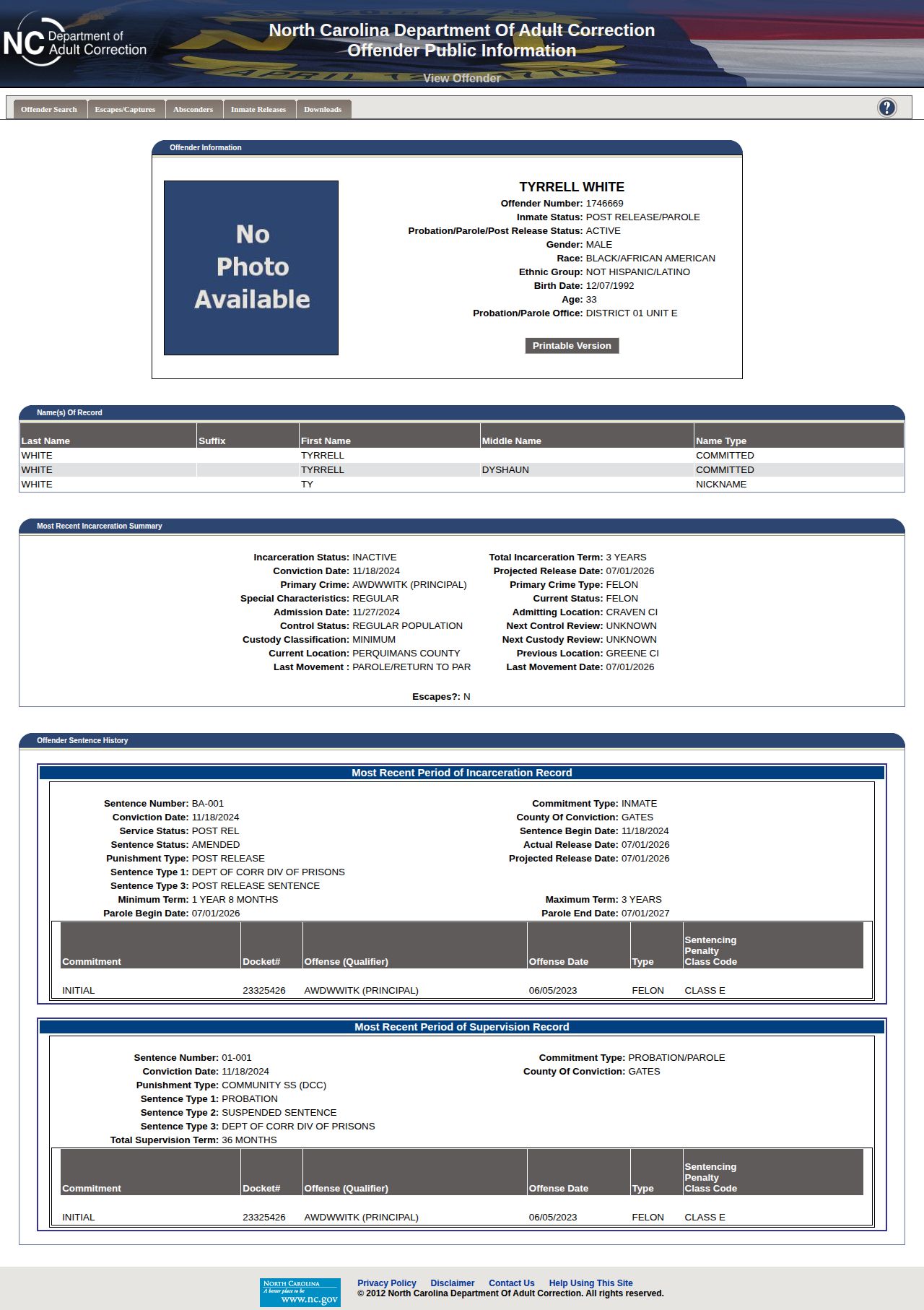
Read the date inside its sentence block, then return to the record header to confirm current status.
Perquimans OPI Sentence Fields
OPI offers more than one date. Search results can be filtered by status, name, sounds-like spelling, offender number, sex, race, ethnic group, birth date or range, and age range. Those inputs help identify the correct record. The detail view then supplies the context needed to decide whether the displayed projection belongs to the controlling sentence.
| OPI field | Release-date use |
|---|---|
| Inmate Status | Shows whether state incarceration is active or inactive at the record level. |
| Probation/Parole/Post Release Status | Shows whether a community phase is active after prison or for a separate sentence. |
| Current location and incarceration status | Identifies the state custodian and present prison status. |
| Projected Release Date | Reports NC DAC’s current calculation for the sentence block. |
| Actual Release Date | Records that incarceration ended for the listed block. |
| Service and sentence status | Helps determine whether that block remains active or is historical. |
| Minimum and maximum term | Shows the judicial sentence structure to which lawful credit rules apply. |
County of conviction and release county are also different ideas. NC DAC’s monthly released-offender search permits a Perquimans release-county filter, but that does not turn it into an Albemarle jail list or prove that Perquimans was the county of conviction. Open the offender detail before describing the connection.
The monthly search is useful after a state prison release. It accepts release county, year and month, surname, and a sounds-like choice. Results can include “Release County Not Reported” and “Released To Other State(s).” It is not meant for a day-by-day local jail projection, and the selected month does not replace the offender’s sentence detail.
North Carolina Earned-Time Calculation
North Carolina Structured Sentencing is often described as requiring service of all of the minimum term and about 85 percent of the maximum. The statutes are more exact. G.S. 15A-1340.13(d) requires a person serving an active sentence to serve the minimum term. Earned time can reduce the maximum term, but it cannot take the sentence below that judicial minimum.
G.S. 148-13(a1) directs NC DAC to create rules for earning, forfeiting, withholding, and restoring time. Subsection (e) applies the same credit rules to sentenced people in local confinement. Credits are not a flat number of “good days” that can be subtracted from every sentence. Work, program participation, conduct, classification, and the governing rule can affect the calculation.
The controlling judgment supplies the minimum and maximum terms. NC DAC then applies valid jail credit, earned-time rules, consecutive or concurrent sentence structure, and later changes to create the projected date. A public reader should use the published result rather than reconstruct a calculation from a short case summary.
Note: Earned time may reduce a maximum term, but Structured Sentencing does not permit it to erase the court-imposed minimum.
Why Perquimans Release Dates Change
A projection reflects the information and legal rules then in the sentence record. A later audit can add credit that was missed or correct credit that was entered in error. New court action, discipline, or another sentence can also change the controlling block. The result may move earlier or later.
| Factor | Effect on the release record |
|---|---|
| Earned time | Award, forfeiture, withholding, or restoration changes the maximum-term calculation within statutory limits. |
| Jail credit audit | Verified pre-sentence custody credit may be added or corrected. |
| Court action | An amended judgment, correction, or other order can change the sentence being served. |
| Other sentences | Concurrent or consecutive terms can make a different block control the date. |
| Detainer or hold | Another authority may take custody when one sentence ends, so release from one custodian is not freedom from all custody. |
| Discipline | Loss or restoration of eligible credit may move the calculation. |
Parole is relevant chiefly to eligible offenses committed before October 1, 1994. A grant, denial, changed date, continued review, or rescission can affect an older-law case, but parole eligibility does not promise release. For modern Structured Sentencing, post-release supervision statutes usually control the move from prison to the community phase.
Confirm a Perquimans Release Date
For a state prisoner, return to OPI near the projected date. Compare current inmate and supervision status with any Actual Release Date. An active post-release status can confirm that incarceration ended while the sentence continues in the community. If the public record is unclear, NC DAC’s public-record request is the state fallback for basic conviction, time-served, sentence-length, admission, and release-date information.
For an Albemarle District Jail event, call (252) 335-4844 and request the admission and release date and time, disposition, and destination. Ask whether the exit was bond, court order, time served, sentence completion, transfer, or detainer handoff. A transfer calls for a second check in the receiving system. Court Portal can explain the legal outcome but not the minute staff completed release.
NC SAVAN can provide an event alert for participating jail and state feeds. The Perquimans County VINE inmate check details the search, notification routes, phone PIN, and transfer limits. An alert is useful, but direct confirmation remains the final step.
Perquimans Release to Supervision
G.S. 15A-1368.2 controls when many Structured Sentencing prison terms shift to post-release supervision. In general, Class B1 through E prisoners move to supervision at the maximum term less twelve months and earned time. Class F through I prisoners generally move at the maximum less nine months and earned time. Certain reportable-conviction maximums use a sixty-month component.
This is why an OPI projected release can point to the start of supervision rather than final discharge. Sentence class, offense date, consecutive terms, jail credit, discipline, and special laws can change the result. The statute explains the framework, while NC DAC’s audited calculation governs the displayed date.
Albemarle Jail Date Policy Gaps
The statewide credit statute reaches sentenced prisoners in local confinement, but Albemarle District Jail publishes no local release-date calculation policy. No official weekend or holiday release rule was found either. It would be inaccurate to assume a Friday release practice or subtract a generic daily credit.
For a local Perquimans sentence, obtain the judgment and commitment, ask the jail which credits were applied, and request the actual release entry after the event. That narrow record chain is stronger than a date inferred from sentence length alone.
Perquimans Release-Date Records Requests
When OPI does not resolve a state date, the NC DAC public-record request is the proper state fallback. DAC says basic conviction information, time served, sentence length, admission, and release dates may be public. Internal prison files and community supervision records have confidentiality limits. DAC does not possess Albemarle District Jail records.
Electronic delivery is the state default. Simple matters may take days, while complex requests can take weeks or months. The legal standard is response as promptly as possible, not a guaranteed date. Identify the person, offender number, requested date fields, and relevant sentence so staff can locate an existing record.
For local custody, ask Albemarle for the existing commitment and release entries. Include full name, birth date if known, approximate admission and release range, and the Perquimans arresting agency. Ask for an electronic copy and a cost estimate before costs are incurred.
Perquimans County eCourts Portal can provide a Case Summary and Register of Actions with parties, events, hearings, case status, and disposition, subject to access limits. Use location, party, birth date, case type, case status, and date filters to locate the right matter. A judgment can verify the sentence imposed, but only the jail or NC DAC record establishes the operational release event.
If dates conflict, record which system supplied each one and what the label actually says. A court judgment date, jail release time, projected prison release, actual prison release, and supervision end date can all be valid while describing different stages.
Public Record Search
Sponsored Results