
Federal Custody Release Routes
Immigration custody, federal criminal pretrial custody, and federal prison custody are separate tracks. ICE manages immigration detention and release. The U.S. Marshals Service manages federal pretrial detention, transport, and safekeeping, sometimes through a local or contract jail. BOP confines sentenced federal prisoners. A person may move between these systems without entering the community.
For a Perquimans arrest, Albemarle District Jail can record the physical exit. Its disposition should state whether the person left on a community release or was transferred to another authority. A federal or immigration pickup means the regional jail's custody ended, not that all custody ended. Ask for the destination and then use that agency's record.
Confirm an ICE Custody Release
The ICE Online Detainee Locator System covers people currently in ICE custody, people held by CBP for more than 48 hours, and, under ICE attorney guidance, people released from ICE custody within the last 60 days. It does not search people under 18.
- Use the A-number and country of birth when the number is known. The A-number must contain nine digits, adding leading zeros if needed.
- For a biographical search, enter the exact first and last names and country of birth; date of birth is optional.
- Read the returned custodian and status exactly. Do not broaden an ICE event into a claim about other systems.
- If no result appears, check spelling, A-number format, country of birth, and whether the event may be outside the recent-release window.
- Use the ICE information line or the appropriate legal and case channel when the online result is absent or unclear.
A recent released result supports exit from ICE custody during the locator's scope. It does not show whether the person was removed, transferred, or released into the United States unless the responsible source supplies that specific result.
ICE Release Search Inputs
The locator depends on exact identifiers. A failed query can reflect formatting, spelling, a short coverage window, delayed data, transfer, removal, another custodian, or an event outside ODLS scope. Absence has little historical value and cannot prove release.
| Search route | Required or useful input |
|---|---|
| A-number search | Nine-digit A-number and country of birth. |
| Biographical search | Exact first and last names plus country of birth. |
| Optional detail | Date of birth can help narrow a biographical search. |
| Recent release scope | ICE guidance describes released records within the last 60 days. |
| Age limit | ODLS does not search people under 18. |
Do not place a juvenile's name into ODLS as a workaround for restricted juvenile records. The age boundary is firm, and Perquimans Juvenile Detention Center is a state juvenile facility with its own authorized channels.
Note: No ODLS result is not proof of release, removal, transfer, or freedom from another custodian.
ICE Release Information Contact
ICE's Detention Reporting and Information Line is the documented fallback for basic case information when the online locator does not settle the question. The line offers language help. A caller should have the A-number, full name, country of birth, and other case details that can identify the correct person.
1-888-351-4024
Monday through Friday, excluding holidays
8:00 a.m. to 8:00 p.m. Eastern
Language assistance available
Ask a narrow question: whether ICE currently holds the person, whether a recent ICE release is within the system's scope, or which Enforcement and Removal Operations office handles the case. Counsel may be needed for a legal status or document that the public line cannot disclose. Do not ask the Perquimans Sheriff to interpret an ICE status merely because a local arrest occurred first.
No Perquimans ICE facility or local ICE detention contract was verified. The ICE route applies only when a detainer, handoff, or immigration case is documented.
U.S. Marshals Release Records
The U.S. Marshals Service has no public historical released-prisoner locator comparable to BOP. Its Justice Detainee/Prisoner Tracking records are internal and cover identity, placement, safekeeping, and disposition during federal proceedings. A person may be physically held at a local or contract jail while legally in USMS custody.
Use the federal criminal docket to identify detention orders, appearances, sentencing, and case status. Ask the physical jail to describe its own transfer or exit entry. Use counsel or the appropriate federal channel for information that is not public. Once a sentenced person enters BOP custody, the BOP locator becomes the public federal-prison route.
A local facility's word released can be operational shorthand for release to the Marshals Service. The destination field matters. A transport to court, another jail, or BOP is not a community release. The strongest statement identifies both the physical facility and the legal custodian on the event date.
BOP and Immigration Boundaries
The BOP Inmate Locator covers sentenced federal prison custody from 1982 to present. Its Released or Not in BOP Custody label does not answer whether ICE or USMS took custody. In the other direction, an ICE result does not establish what happened in a federal criminal sentence.
The official BOP screen below is included because it shows the separate federal-prison route that must be checked when a case moves beyond USMS pretrial custody.
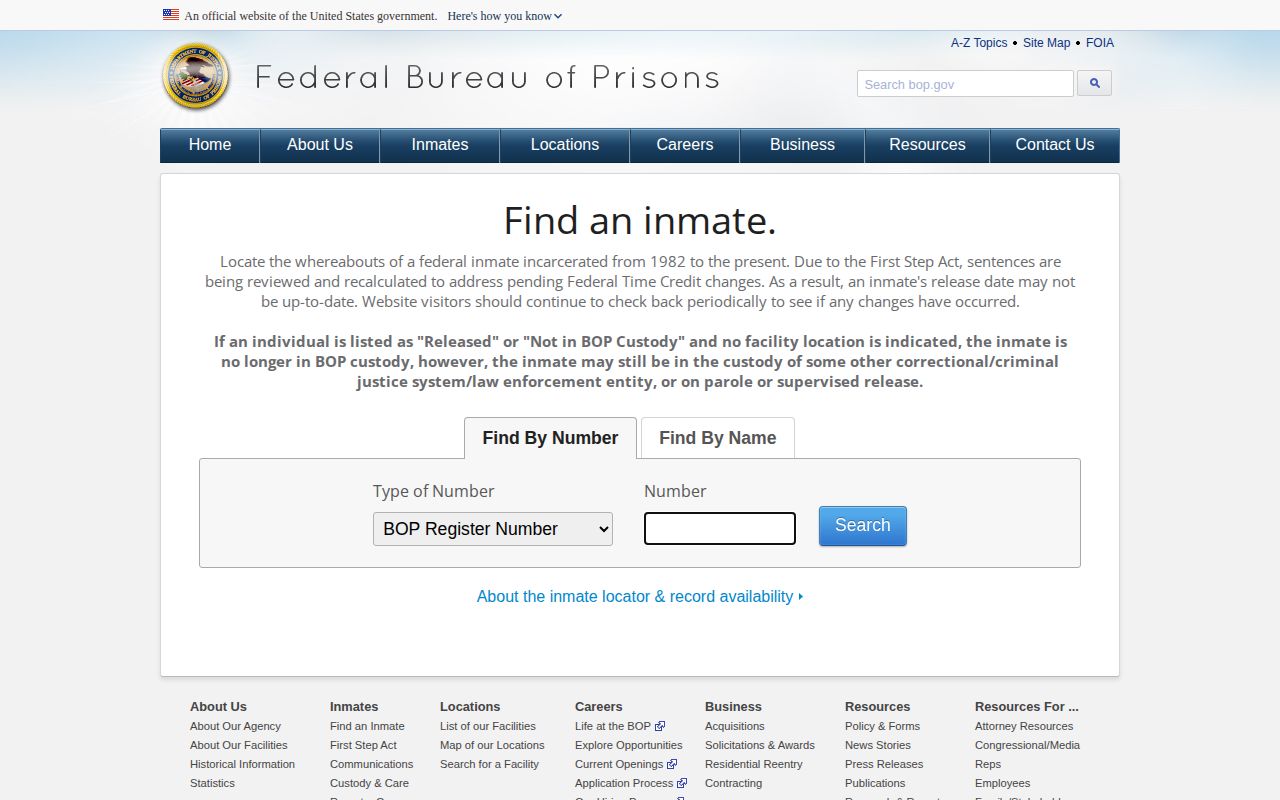
The BOP result should be compared with the ICE locator and federal docket only when the facts show those systems may overlap.
| Authority | Public verification route |
|---|---|
| ICE | ODLS for current custody and a limited recent-release period. |
| USMS | Federal docket, physical custodian, and authorized federal or counsel channel. |
| BOP | BOP locator for sentenced federal prison custody. |
| Albemarle District Jail | Jail release or transfer entry for the local physical-custody event. |
Perquimans Detainer Transfers
A detainer signals that another authority may take or continue custody. The term does not, by itself, state that ICE or USMS made the request. Ask Albemarle District Jail to identify the releasing disposition and destination. Then confirm the handoff with the named agency. No research source supports a routine ICE arrangement at the regional jail or anywhere else in Perquimans County.
Several outcomes must remain distinct. Release into the United States is not the same as removal from the country. Transfer to another detention site is not release. USMS pickup is not entry into BOP until the federal prison system records the person. A state or county hold belongs in that jurisdiction's custody record.
- Detainer
- A basis or request for another authority to take or keep custody.
- Transfer
- Movement from one custodian or site to another.
- Removal
- An immigration outcome that must not be mislabeled as community release.
- Release into the United States
- An exit from ICE custody described by the responsible immigration record.
Build a Federal Custody Chain
A clear record chain starts with the first documented custodian and follows each named destination. For a Perquimans local event, obtain Albemarle's admission and release or transfer entries. Use the Perquimans court case for local legal context. If the disposition names ICE or USMS, move to the immigration locator or federal docket. If sentencing leads to BOP, use the federal prison locator.
Record the source, lookup date, exact name spelling, identifier, agency, status label, and event date. A-number, BOP register number, county booking number, NC DAC offender number, and court case number are not interchangeable. Protect identifying information that is not needed for the custody question.
The age of the source also matters. ICE's public locator has a limited recent-release scope, while the Marshals Service offers no comparable historical public locator. A later empty search cannot erase a dated Albemarle transfer entry or a federal docket event. Keep a copy or citation for each public record, note the time it was checked, and ask the agency that owns a disputed entry to clarify it. This preserves the difference between a current status check and a historical custody record.
When sources conflict, ask whether they describe different stages. A jail exit, federal pickup, ICE booking, BOP admission, and later release can all have different dates. The narrow conclusion should attribute each event to the agency that created it instead of collapsing the chain into one unsupported release date.
Public Record Search
Sponsored Results