
Perquimans Parole and Probation Compared
North Carolina uses several community statuses that can look alike in a brief search result. Probation is imposed by a court, often with a suspended sentence, and may exist without a state-prison release. Parole is discretionary release under older sentencing law. Structured Sentencing ended parole for offenses committed on or after October 1, 1994, so parole now chiefly concerns eligible older-law cases. Post-release supervision is the community phase required by statute for many modern prison sentences.
The North Carolina Post-Release Supervision and Parole Commission is the releasing authority in eligible parole cases and sets post-release conditions. NC DAC Community Supervision carries out field supervision. These roles matter when a record has both an incarceration status and a supervision status.
The Commission’s official overview shows how parole authority and post-release supervision fit within NC DAC. The source view below preserves that agency context.
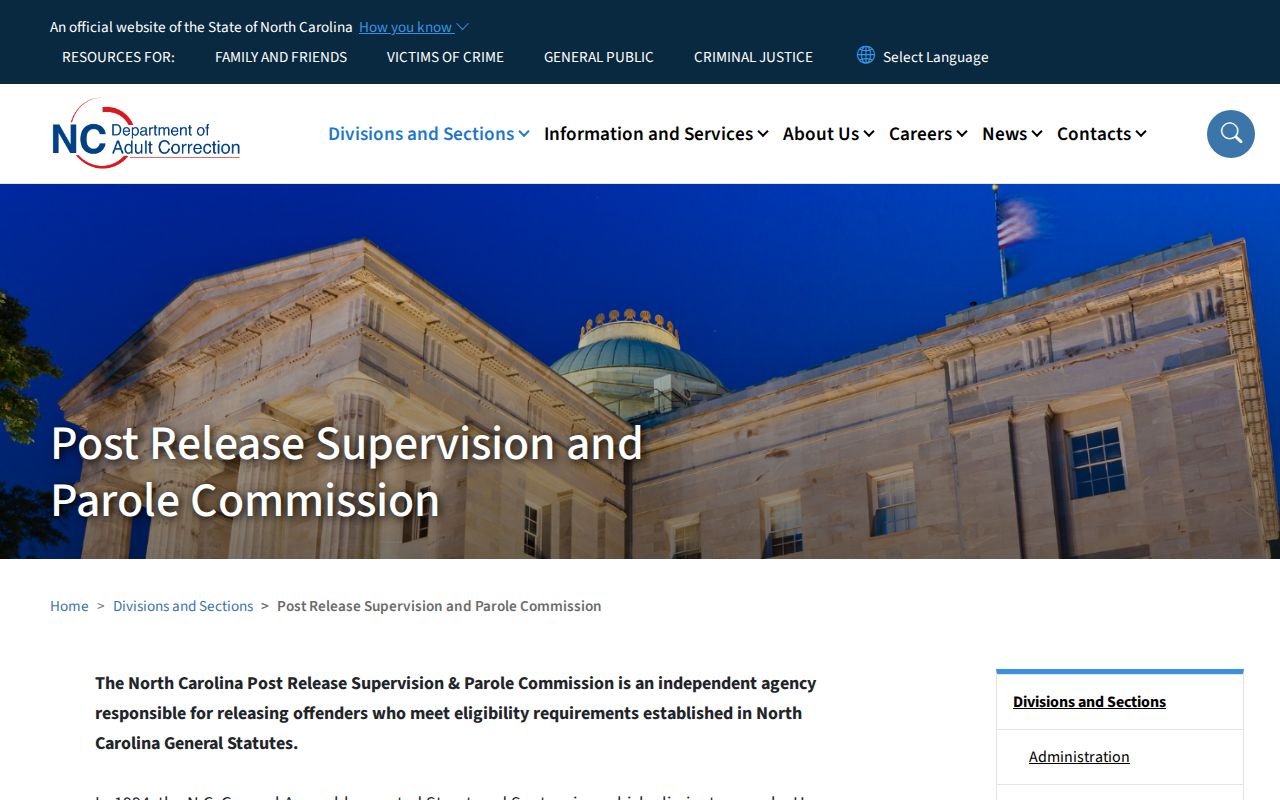
Use the Commission source for its legal role, then use OPI for the public status of one named person.
| Status | How it begins | What release means |
|---|---|---|
| Probation | Court sentence or suspended sentence | The person may be in the community without a prior state-prison release. |
| Parole | Commission action in an eligible older-law case | Prison custody ends, but the sentence continues under conditions. |
| Post-release supervision | Statutory community phase after prison | An actual prison release may appear while supervision remains active. |
| Discharge | Completion or lawful termination of supervision | The relevant sentence or supervision term has ended as recorded. |
Note: An active probation entry does not by itself prove that the person was recently held at Albemarle District Jail.
Check Perquimans Post-Release Supervision
The public verification route is NC DAC Offender Public Information, or OPI. Search with the person’s offender number when possible because it is more precise than a name alone. If only a name is known, compare birth details and other identifiers before treating a result as a match. OPI covers state prison and community supervision history beginning in 1972. It does not contain Albemarle District Jail booking records.
- Open the NC DAC OPI offender search and select a status broad enough to include active probationers, parolees, and inactive prison records.
- Search by offender number or by full name. Use birth date, age, or other listed filters to separate people with similar names.
- Open the detail record and read “Inmate Status” apart from “Probation/Parole/Post Release Status.” Do not stop at the first status label.
- Compare incarceration status, Actual Release Date, supervision begin and end dates, current county or location, and any named office.
- Use the current District 1 directory to confirm the proper public office. For a case outcome, check the court judgment as well.
A common valid pattern is INACTIVE incarceration with ACTIVE POST RELEASE/PAROLE supervision. That means the person left prison and entered the community phase. It is not final discharge. If OPI instead shows an active probationer, the court judgment helps determine whether probation followed a suspended sentence, a split sentence, or another case outcome.
Perquimans Community Supervision Office
Perquimans County belongs to Community Supervision Judicial District 1 with Camden, Chowan, Currituck, Dare, Gates, and Pasquotank counties. The current NC DAC district directory is the best public source for office routing. An older directory shows a different telephone number, so confirm the current listing before a visit.
NC DAC Community Supervision, District 1
District Manager Jennifer Gallop
1023 US 17 South, Suite 3
Elizabeth City, NC 27909
Phone: (252) 621-6129
Fax: (252) 331-4841
The office can explain public routing or how a supervised person can reach the appropriate office. It should not be expected to disclose private case notes, treatment details, check-in schedules, risk data, or a private address. North Carolina law treats community supervision records as confidential under G.S. 15-207, even though OPI provides a limited public status view.
Perquimans Violations and Absconder Status
Supervision conditions come from the court, statute, and the responsible Commission or supervision authority. A public record may show an active status, office, dates, or an absconder notation, but it will not provide the full working file. An absconder status means the agency alleges that contact was lost or that supervision rules were not followed. It is not a new conviction, and it does not prove current physical custody.
A violation may lead to an investigation, modified conditions, a court or Commission response, or custody, depending on the case. Do not infer the result from a stale status or a missed alert. Review OPI again, check the public court docket where the matter is court-controlled, and use the listed office for proper routing. NC SAVAN can provide custody and supervision event notices from participating feeds, but an alert is not a substitute for the agency record.
The statewide NC SAVAN service joins jail data with Adult Correction prison, probation, and parole feeds. It can send supported notices for custody or supervision events, yet it is not a complete supervision file. A public OPI status and a SAVAN notice should therefore be treated as two views of agency data, not as independent court findings. If either conflicts with a current court order or a direct agency response, record the source and lookup date, then ask the responsible office to reconcile the difference.
- Absconder
- A person whom the supervising agency alleges has stopped reporting or cannot be located as required.
- Detainer
- A request or authority that can keep custody in place for another agency or case.
- Discharge
- The recorded end of the sentence or supervision term, not merely departure from prison.
When Perquimans Supervision Ends
Release from prison and discharge from the sentence are separate events. Under G.S. 15A-1368.2, many people move from prison to post-release supervision before the maximum term expires. For Class B1 through E sentences, the statute generally uses the maximum term less twelve months and earned time. Class F through I sentences generally use the maximum less nine months and earned time. Covered reportable convictions can use a sixty-month component.
The supervision period is generally twelve or nine months, with five years for covered reportable convictions. The sentence date, offense class, credits, and special rules control. OPI should be read instead of trying to recreate NC DAC’s calculation. When the record shows the supervision term complete and the sentence terminated as provided by law, “discharged” is appropriate. Before that point, describe the person as released from incarceration and active on supervision.
For the broader release record and court confirmation path, use the Perquimans County released inmate search. It separates a jail exit, a state-prison release, and final sentence discharge.
Perquimans Parole Review Records
The Commission does not hold formal hearings or meet personally with offenders. It reviews eligible cases one at a time. As a result, there is no public hearing calendar or routine cadence to search. No general decisions database was found either. The Commission’s Media Notifications page contains a limited set of notices about investigations, Mutual Agreement Parole Program matters, grants, and changed parole dates, but it is not a full results archive.
Possible case outcomes can include grant, denial, continued review, a changed date, or rescission. Only state an outcome when a source records it. The Commission treats denial reasons as confidential, so silence on the media page cannot be turned into a denial. OPI date and status history, paired with direct Commission contact when appropriate, is stronger evidence for one person.
Eligibility is also not a promise of release. G.S. 15A-1371 supplies detailed rules for eligible older-law sentences, including minimum-term and credit provisions. The official parole process explains the older sentencing framework and exclusions. The record must show what the Commission actually decided.
Where a sentence has a minimum, the statute generally ties eligibility to service of the minimum or one-fifth of the maximum penalty allowed by law, whichever is less, minus specified credit. Other provisions apply to Fair Sentencing Class D through J felonies, certain life cases, impaired-driving matters, and community-service rules. These details make a casual calculation unsafe. Confirm the offense date and governing sentence before using any eligibility statement.
A parole date can also change before release. A grant may later be modified or rescinded, and a case may remain under review. For that reason, use the latest OPI entry and an express Commission source. A past media notice should not be treated as a current custody certificate.
Perquimans Regional Reentry Contact
The statewide reentry-resource directory assigns Perquimans County to a regional Commerce reentry coordinator rather than listing a county reentry office. That distinction prevents a referral to an office that research did not confirm. The directory lists Victor Hinnant at (919) 607-0645 and victor.hinnant@nccommerce.com.
Because regional assignments can change, confirm the listing in the statewide reentry-resource directory before sharing the contact. This resource is separate from supervision. The coordinator does not replace the District 1 office, alter conditions, or verify a legal status.
Perquimans Release Funds and Property
Albemarle District Jail’s official inmate-funds policy says money left in an account is returned by debit card when a person is released or transferred for more than 24 hours. The person signs a receipt. This is a local release detail, not a rule about state supervision funds.
The policy does not state how other personal property or identity papers are returned. Ask the jail about those items. Corrections to an OPI or court record should go to the agency that created it, while registry issues belong with the sheriff or registry channel. A supervision office should not be used as the catch-all records custodian.
Public Record Search
Sponsored Results